My five-year-old daughter told her kindergarten teacher, “My stepdad counts my bones at bedtime.” The teacher called me at work. I stopped breathing. I was standing in aisle seven at CVS, holding a box of allergy medicine in one hand and a pricing gun in the other. Fourteen dollars and fifty cents an hour.
A name tag that said Mia’s Mom because one of my coworkers had made it as a joke. A half-empty bottle of water behind the register. None of it mattered after that phone call. “Mrs. Walker?” the teacher said.
Her voice was too careful.
Too calm.
The kind of calm adults use when they are trying not to scare someone before they say something terrible.
“Yes,” I said. “Is Mia okay?”
There was a pause.
“She’s safe right now. She’s with the school counselor.”
My heart dropped.
“What happened?”
“Mrs. Walker, Mia said something during circle time that concerned us.”
I gripped the shelf beside me.
“What did she say?”
The teacher inhaled.
“She told me, ‘My stepdad counts my bones at bedtime.’”
For a second, my mind refused to understand.
Counts my bones.
The words sounded strange.
Childlike.
Almost imaginary.
But something inside me went cold before my brain caught up.
“What does that mean?” I whispered.
“She said he turns off the lights and presses on her ribs. She described it as a game. She said it hurts, but he tells her good girls don’t cry.”
The box of allergy medicine fell from my hand.
My manager came around the corner.
“Lena?”
I looked at him, but I could not answer.
The teacher’s voice continued.
“We need you to come to the school immediately.”
I left my shift without asking permission.
My purse was in the break room.
My keys were in my locker.
I do not remember clocking out.
I do remember my manager calling after me, “Go. I’ll cover it.”
That kindness nearly broke me.
The school was twelve minutes away.
I made it in ten.
Every red light felt like an insult.
Every car in front of me felt like a wall.
My hands shook so badly on the steering wheel that I had to keep telling myself out loud, “Drive straight. Breathe. Get to Mia.”
Mia.
My tiny girl with pink sneakers and uneven bangs because she had trimmed them herself with craft scissors.
Mia, who loved pancakes with blueberries and called every dog “sir.”
Mia, who asked permission before taking a cookie from her own lunchbox.
Mia, who had started begging to sleep with the hallway light on.
Mia, who had been saying for weeks, “I don’t like bedtime when you work late.”
And I had thought she meant nightmares.
I had thought she meant missing me.
I had thought everything except the truth.
When I reached the school, the secretary took one look at my face and stood.
“She’s in the counselor’s office.”
I followed her down the hallway.
The walls were covered with paper suns, alphabet charts, and little handprints made from orange paint.
Everything looked bright.
Safe.
Normal.
Then I saw my daughter through the counselor’s door.
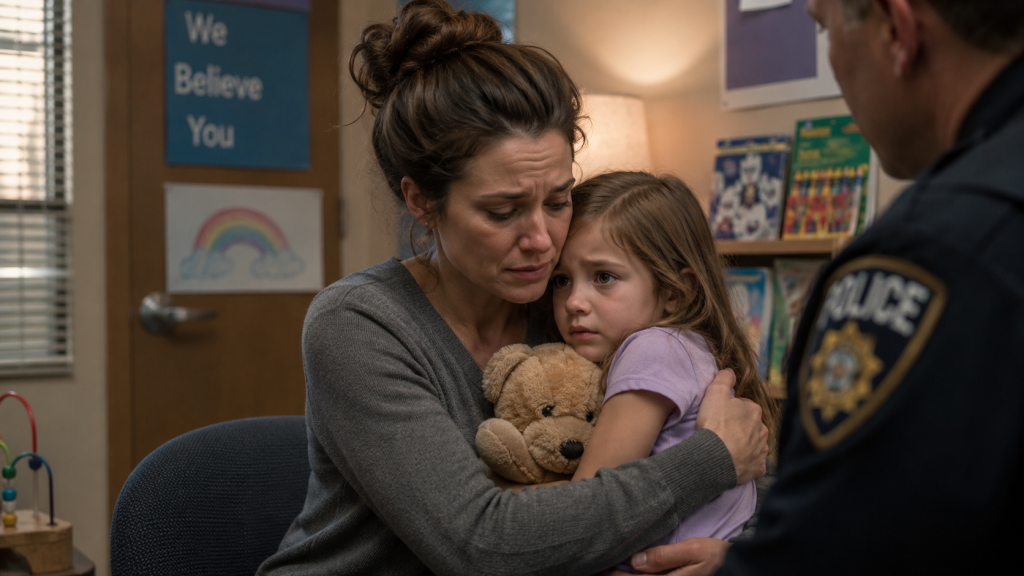
She was sitting in a chair too big for her, holding a teddy bear against her chest.
Her small shoes did not touch the floor.
Her teacher sat beside her, eyes red.
The counselor, Ms. Delaney, stepped into the hallway and closed the door gently behind her.
“I’m so sorry,” she said.
That sentence is dangerous.
It means the world has already changed and everyone else knows it before you do.
“What did she say?” I asked.
Ms. Delaney spoke carefully.
“She described it as a nighttime game. She said your husband waits until you are at work or asleep. She said he tells her it is their secret.”
My knees weakened.
I reached for the wall.
Ms. Delaney continued.
“She did not use adult words. But what she described is enough that we are mandated to report immediately.”
I could not stand.
I slid down the hallway wall and sat on the floor.
My husband.
Four years married.
Daniel.
The man who packed Mia’s lunch when I worked early shifts.
The man who carried her on his shoulders at the county fair.
The man who kissed my forehead and told me I finally had help.
Help.
That was what I called him.
I had been a single mother at twenty-three.
Exhausted.
Broke.
Always choosing between rent, groceries, and gas.
Daniel arrived like answered prayer.
He was patient at first.
Gentle.
Good with Mia in public.
The kind of man people praised.
“You found a good one,” they said.
“He stepped up.”
“Not every man would raise another man’s child.”
I heard that sentence so many times I began to treat his presence like a favor.
Like Mia and I owed him gratitude for staying.
Now I sat on the floor outside the counselor’s office, realizing my daughter may have been paying the price for that gratitude.
I pulled my phone from my purse and called 911.
My voice did not sound like mine.
“My daughter disclosed something at school. She is five. I need police here.”
The dispatcher asked questions.
I answered what I could.
The officer arrived eight minutes later.
His name was Officer Grant.
He was tall, broad-shouldered, with a voice so gentle it made me want to cry.
He did not rush into the room.
He spoke first with Ms. Delaney and the teacher.
Then he asked if he could speak with Mia.
I wanted to hold her the whole time.
I wanted to put my body between her and every question.
But the counselor explained that children need space to answer without trying to protect a parent.
So I stood outside the open doorway where Mia could still see me.
Officer Grant knelt in front of her chair.
“Hi, Mia. I’m Officer Grant. Your bear looks very brave.”
Mia looked down at the teddy bear.
“His name is Toast.”
“That’s a great name.”
She nodded seriously.
“He is brave.”
Officer Grant asked only two gentle questions.
Nothing harsh.
Nothing leading.
“Can you tell me what you told your teacher?”
Mia looked toward me.
My heart stopped.
I said softly, “You can tell the truth, baby. You are not in trouble.”
Her lip trembled.
Then she whispered.
I could not hear every word.
I heard enough.
Officer Grant’s expression changed.
Not dramatically.
But something hardened behind his eyes.
He stood, stepped into the hallway, and radioed for backup.
Then he looked at me with a seriousness I will never forget.
“Ma’am,” he said quietly, “based on what your daughter described, your husband has been hurting her for a long time.”
My body went cold.
Then Mia whispered from behind the door, “Mommy, he said you wouldn’t believe me.”
That sentence cut deeper than anything else.
Because that was the weapon.
Not only fear.
Doubt.
He had counted on my disbelief before I even knew there was something to believe.
I stood up shaking.
“He was wrong,” I said. “I believe every word.”
Mia began to cry then.
Not loud.
Not like a tantrum.
Like a child whose body finally understood she was allowed to be rescued.
I went to her and knelt on the floor.
She leaned into me, still clutching Toast.
“I’m sorry,” she sobbed.
“No,” I said immediately. “No, no, no. You never apologize for telling me.”
“He said you’d be mad.”
“I’m not mad at you.”
“He said he would go away and then we’d be poor again.”
My throat closed.
There it was.
The fear he had used on both of us.
Money.
Shelter.
Need.
The old panic of being alone.
I held her face gently.
“Mia, listen to me. I would rather live in a tiny room with you safe than in any house with someone who hurts you.”
She cried harder.
Officer Grant arranged for a child advocacy team.
A detective arrived.
A social worker came.
I answered questions until my mouth felt numb.
Where was Daniel now?
At work, I said.
Did he have access to the school pickup list?
Yes.
That was changed immediately.
Did he know Mia had disclosed?
No.
Not yet.
The detective advised me not to call him.
“Let us handle contact,” she said.
I nodded.
I had spent four years calling Daniel first.
For bills.
For decisions.
For anything that felt hard.
Not anymore.
They took Mia to a specialized clinic where children could be examined gently and safely.
I will not describe that part.
Some things belong only to the child who survived them.
I sat in the waiting room gripping a paper cup of water so tightly it collapsed in my hand.
Ms. Delaney stayed with me.
She did not have to.
Her workday had ended hours earlier.
“She said it during story time,” she told me quietly.
“What?”
“Mia was holding a toy skeleton from the science shelf. Another child said bones were funny. Mia said hers got counted at bedtime.”
I covered my mouth.
“It was so casual,” Ms. Delaney said, her voice breaking. “That’s what scared me.”
Children sometimes reveal horror in the language of routine.
A game.
A secret.
A bedtime thing.
Adults must learn to hear the alarm beneath the small words.
Daniel was arrested that evening.
I learned it from Detective Harris, not from seeing him.
Thank God.
He had been picked up at his workplace.
He denied everything.
Of course he did.
He said Mia had a big imagination.
He said I was vindictive.
He said I had been stressed about money and must have coached her.
The detective told me this gently, as if afraid it would shock me.
It did not.
By then, I understood something ugly.
Men who hurt children often prepare the defense before anyone accuses them.
“She lies.”
“She’s dramatic.”
“She wants attention.”
“Her mother coached her.”
Different words.
Same escape route.
That night, Mia and I did not go home.
My manager, the one who had told me to leave work, arranged for us to stay with his sister for two nights.
Then a domestic violence advocate helped us find emergency housing.
I left the house with police escort the next day.
Daniel’s toothbrush was still by the sink.
His work boots by the door.
His mug in the drying rack.
Ordinary objects suddenly looked like evidence of a life I had misunderstood.
I packed Mia’s clothes.
Her birth certificate.
My documents.
Her favorite books.
Toast.
A framed photo of my grandmother.
I left my wedding ring on the kitchen counter.
Not dramatically.
Just because I did not want it touching my hand anymore.
Mia stood by the officer, watching me pack.
“Are we moving?” she asked.
“Yes.”
“Will he know where?”
“No.”
“Promise?”
I looked at the officer.
Then back at my daughter.
“Promise.”
The first weeks were a blur.
Court dates.
Protective orders.
Interviews.
Therapy intake forms.
Calls from relatives who could not understand how “nice Daniel” could be accused of something so terrible.
His mother called me crying.
“There must be a mistake.”
I said, “The mistake was trusting him.”
She said, “You’re ruining his life.”
I looked at Mia coloring quietly on the shelter floor.
“No,” I said. “He tried to ruin hers.”
Then I hung up.
Some people chose disbelief because belief would require them to rearrange their whole world.
I did not have that luxury.
My whole world had already rearranged itself around my daughter’s truth.
Mia changed after she told.
Not all at once.
There was no magical healing.
She had nightmares.
She panicked when lights turned off.
She cried if someone knocked unexpectedly.
She asked me every night, “Are you sure you believe me?”
Every night, I answered, “Yes.”
Sometimes five times.
Sometimes ten.
I learned not to get tired of the question.
Children who have been taught doubt need repetition as medicine.
Her therapist, Dr. Larkin, helped both of us.
She explained that safety is not one sentence.
It is a thousand small proofs.
A door left open.
A nightlight.
A mother who does not sigh when woken.
A bedtime routine where no one is afraid.
We built new routines.
Bath.
Pajamas.
Two books.
A cup of water.
Hallway light on.
Toast tucked under her arm.
Then I would sit beside her bed until her breathing slowed.
Sometimes she asked, “Can you count stars instead?”
So we did.
Not bones.
Never bones.
Stars.
One star for bravery.
One for telling.
One for teachers who listen.
One for police who kneel.
One for mommies who believe.
Months passed.
The case moved slowly.
Too slowly.
Legal time is cruel when a child has already told the truth.
Daniel’s attorney tried to make Mia sound confused.
The prosecutor warned me it would be difficult.
“She is very young,” she said.
“She is very clear,” I replied.
Mia did not have to testify in the way I feared.
Her forensic interview, medical records, and other evidence became part of the case.
I thanked God for her teacher every day.
If that teacher had brushed it off as a strange comment, I might still be living with a monster.
I wrote her a letter later.
You saved my daughter because you listened to one sentence no adult should ignore.
She wrote back:
Mia saved herself by speaking. I was lucky enough to hear her.
The trial ended in a plea.
Daniel admitted enough to avoid making Mia go through more.
The sentence was not everything I wanted.
Nothing could be.
No number of years can return a child’s sense of safety.
But there were consequences.
There was a record.
There was a protective order.
There was no more pretending.
When the judge spoke about the abuse of trust, I held Mia’s small sweater in my lap.
She was not in the courtroom.
She was at therapy with Dr. Larkin, drawing planets.
I liked that better.
Let adults sit with the ugliness.
Let children draw planets.
After court, I walked outside into bright sunlight and felt strangely empty.
Nicole, my coworker from CVS, hugged me.
My manager was there too.
So was Ms. Delaney.
People I had not expected to become family stood beside me on the courthouse steps.
I cried then.
Not because it was over.
Because I knew healing was just beginning.
A year later, Mia turned six.
We had moved into a small apartment with yellow curtains and a balcony that faced a parking lot.
It was not fancy.
The heater rattled.
The kitchen drawer stuck.
The upstairs neighbor vacuumed at strange hours.
But it was ours.
Safe.
On her birthday, Mia wore a purple dress and a crown from the dollar store.
Her cake had planets on it.
She blew out the candles and wished silently.
Later, while I washed dishes, she came into the kitchen holding Toast.
“Mommy?”
“Yes, baby?”
“I wished that other kids tell their teachers too.”
I turned off the faucet.
Water dripped from my hands.
I knelt in front of her.
“That is a beautiful wish.”
She looked at me seriously.
“And that their mommies believe them.”
My throat tightened.
“Yes,” I whispered. “Me too.”
She climbed into my arms.
She was getting bigger, harder to hold for long, but I lifted her anyway.
For a moment, I thought about the woman I had been that day at CVS.
Tired.
Underpaid.
Worried about bills.
Thinking survival meant keeping everything together at any cost.
I wanted to tell her the cost was too high if the price was her child’s silence.
I wanted to tell her that leaving work would be the first right thing in a long chain of terrifying right things.
I wanted to tell her she would lose the house, the marriage, the illusion of help, and several people who preferred Daniel’s mask to Mia’s truth.
But she would keep her daughter.
And that would be everything.
Now, every night, I still sit beside Mia’s bed.
Not because she always needs me to.
Sometimes she falls asleep before the first book ends.
But I stay for a few minutes anyway.
The hallway light glows softly.
Toast rests under her arm.
Glow-in-the-dark stars cover the ceiling.
Sometimes, half asleep, she whispers, “Count stars?”
And I do.
Quietly.
One.
Two.
Three.
Four.
Five.
Stars for every brave word.
Stars for every adult who listened.
Stars for every night that belongs only to peace now.
My five-year-old told her kindergarten teacher, “My stepdad counts my bones at bedtime.”
That sentence almost destroyed me.
But it also saved her.
Because a teacher listened.
A counselor believed.
An officer knelt.
And I, finally, chose my daughter’s truth over the life I was afraid to lose.
Daniel said I would not believe her.
He was wrong.
I believed every word.
And the moment I did, my daughter stopped carrying the secret alone.
THE END! THANK YOU FOR READING!